.svg)
 AI for Safety & Security" />
AI is rapidly transforming the way nations protect their citizens and respond to emerging threats. From predictive analytics that anticipate disasters before they strike, to real-time monitoring systems that detect anomalies across critical infrastructure, AI is redefining how public safety and homeland security agencies operate. It changes how they analyse information, interact across agencies, make decisions, and act under pressure. The challenge is clear: leverage AI’s power responsibly while maintaining privacy, transparency, and control. This page explores how AI strengthens national resilience, integrating insights from Intersec’s field expertise and innovation leadership, where technologies for metadata intelligence, situational awareness, and crisis management are shaping the next generation of civil defence.
Table of contents
- Why AI matters for Public Safety & Homeland Security
- Key use cases
- Highlight: AI-assisted early warning systems (EWS)
- The critical role of telecom operators
- Ethical and legal foundations of responsible AI
- The Intersec’s AI approach to map real needs
- The Intersec AI technology for Homeland Security
Why AI matters for Public Safety & Homeland Security
Public safety and homeland security share a single mission: protecting people and institutions from harm. Yet the environments they operate in are increasingly complex: natural disasters, conflicts, terrorism threats, pandemics and industrial risks… AI helps public agencies see, decide, and act faster. Through advanced analytics, geolocation data, and real-time monitoring, AI systems enable authorities to:
- Detect and analyse unusual activity before it escalates
- Coordinate rapid response during emergencies
- Allocate limited resources efficiently
- Strengthen resilience across energy, transport, telecom, and urban systems
In homeland security contexts, AI adds a predictive and integrative dimension, helping agencies connect the dots between diverse data sources: network metadata, smart cities, connected vehicles, social media signals, environmental sensors... When responsibly managed, this fusion of data creates a powerful foundation for proactive national defence and public safety management.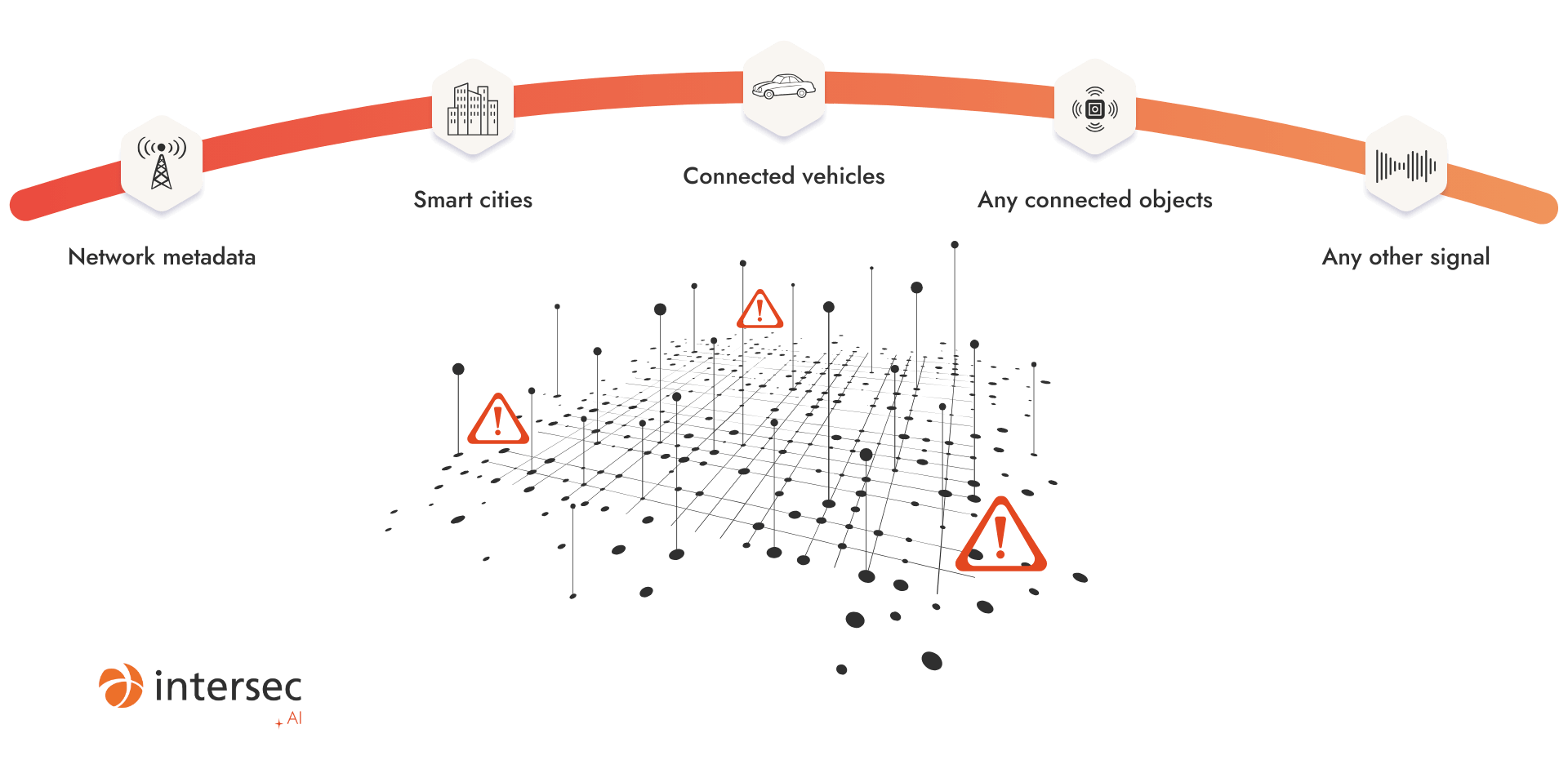
Applied to network metadata, AI-driven mobility and activity models use large-scale data to learn how movements and behaviours evolve across space and time. By identifying patterns, trends, and anomalies at different levels of aggregation, these models provide a dynamic representation of how people, vehicles, and assets interact with their environment. This data-driven understanding supports the design of predictive and adaptive systems that can be applied to a wide range of safety and security contexts.
Key use cases
FOR EMERGENCY SERVICES
Climate resilience: As climate-related disasters become more frequent and severe, governments are increasingly adopting AI to strengthen preparedness and mitigation efforts. Use cases range from continuous risk monitoring and real-time situational awareness to predictive modelling, AI-supported public alerts, and evacuation planning. AI-driven mobility and activity models at scale provide critical intelligence to support effective crisis management.
Emergency response: In disaster scenarios where every minute counts, AI enhances the ability of emergency services to evaluate affected areas, anticipate population movements, and better coordinate first responders. For example, combining real-time telecommunications data with geographic information systems (GIS), information systems, and real-time sensors can help identify emerging constraints or disruptions. This integrated view supports adaptive decision-making, such as adjusting evacuation strategies in real time and delivering public warnings more precisely and effectively.
Emergency calls: Operators must route emergency communications quickly and accurately, providing precise caller location data. AI helps predict spikes in call volumes, transcribe speech in real time, prioritize call traffic by level of urgency through the analysis of noises and sounds, and deliver meter-level caller location accuracy. For emergency services, this means faster, smarter, and more effective responses.
FOR CORPORATE SAFETY
Critical infrastructure protection: Energy grids, transportation networks, and communication systems are the backbone of national resilience. AI-driven predictive maintenance models detect faults before they cause outages, while computer vision monitors access points and detects tampering. When combined with geospatial intelligence, these capabilities enhance early warning for sabotage, natural disasters, or equipment failure.
Threat and anomaly detection: AI systems trained on historical event data and live sensor inputs can identify unusual behaviours in real time, from cyber intrusions to crowd surges or irregular movement patterns near sensitive facilities. By prioritizing alerts and reducing false positives, such tools enable operators to focus on genuine risks rather than noise.
Emergency planning: AI can propose appropriate response actions based on specific situations and contexts. By parameterizing pre-established response plan models, it can adapt standard procedures to real-time conditions such as location, scale, available resources, and evolving risks. This allows decision-makers to quickly generate tailored response options that remain consistent with approved emergency frameworks while improving speed, coordination, and effectiveness.
FOR SECURITY SERVICES
Law enforcement: Conventional policing largely depended on post-incident reporting. Today, AI enables the real-time identification of suspicious behaviours and, in some cases, the anticipation of incidents before they occur. As data volumes grow exponentially, AI-driven solutions have become essential for law enforcement and intelligence agencies to detect threats, disrupt organized crime networks, and counter terrorism, all while operating under stringent regulatory oversight. Service providers are increasingly expected to deliver AI-supported investigative and monitoring tools that strengthen national security.
Advanced investigative analytics: Machine learning and large language models can support investigations by uncovering correlations in large volumes of digital evidence: communications metadata, imagery, and transactional data. Used within strict legal frameworks, these capabilities enhance investigative efficiency while maintaining transparency and oversight.
Border and maritime security: AI-powered geolocation and pattern recognition enhance border surveillance and maritime domain awareness. Combining radar, satellite, and telecom signals allows for real-time anomaly detection, identifying irregular vessel movements or illegal crossings while minimizing manual monitoring workloads.
Highlight: AI-assisted early warning systems
AI is reshaping early warning systems by enabling a shift from reactive alerting to proactive risk management. Where traditional systems waited for crises to materialize, AI now allows authorities to anticipate climate-driven and man-made threats well in advance. By continuously analyzing heterogeneous data sources, such as environmental sensors, network signals, and historical incident patterns, AI supports scenario modelling, risk forecasting, and preparedness activities. This includes simulation-based training and pre-event planning, helping crisis teams test responses, refine alert strategies, and build operational readiness before an incident occurs.
When a crisis unfolds, AI acts as a force multiplier for faster and more adaptive response. It supports real-time monitoring of evolving conditions and enables continuous updates to CAP alerts as situations change. AI can automatically generate alert messages, recommend the most effective communication channels and geographic zones, and assist operators by translating messages into local languages or dialects and adapting content to different audiences. These capabilities are especially valuable when stress peaks, as they reduce cognitive load and help maintain clarity, consistency, and speed across large-scale alerting operations. More advanced implementations extend to predictive monitoring, where AI can suggest or trigger alerts as thresholds are approached, rather than after they are crossed.
Throughout these advancements, a core principle remains unchanged: human validation is essential. Conference discussions repeatedly underlined that AI does not replace crisis-management professionals but augments their expertise. Decisions to issue, modify, or escalate alerts remain firmly in human hands, ensuring accountability, trust, and ethical oversight. In this model, AI enhances judgment, accelerates execution, and improves resilience, while keeping people at the centre of early warning and public safety systems.
Related content:
- Blog post: AI for Good summit: Key takeaways on advancing Early Warning Systems (EWS)
- Conference replay: Impact of AI on CAP-enabled crisis management
The critical role of telecom operators
As countries reinforce both civilian and defence capabilities, telecom operators are entering a phase of heightened strategic importance. Their contribution to safeguarding national assets, protecting populations, and strengthening societal resilience is expanding rapidly. This shift is driven by closer cooperation between public authorities and operators, built around an “all-hazards, all-threats” framework. In this context, AI is transforming how telecom infrastructures support essential functions, from crisis management and emergency communications to homeland security.
This direction was strongly highlighted at the ITU’s Global Symposium for Regulators (GSR) held in Riyadh, where policymakers stressed the need to accelerate innovation-friendly regulation. The GSR-25 Best Practice Guidelines identified artificial intelligence, advanced data analytics, international coordination, and regulatory alignment as foundational elements for future governance.
As Dr. Cosmas Luckyson Zavazava, Director of the ITU’s Telecommunications Development Bureau, put it:
“The regulators of today and tomorrow cannot simply be the referee of a known game. They must be the architects of a world in transformation. It means fostering innovation not as a side project, but as a core practice.”
For telecom operators, navigating this evolving regulatory environment goes beyond meeting regulatory obligations. It represents a long-term commitment to public safety innovation and sustainable sector development.
Ethical and legal foundations of responsible AI
Responsible adoption is as important as technological innovation. AI systems that affect public safety operate at the intersection of security, privacy, and human rights. Governments and telecom regulators must therefore adopt clear governance frameworks to maintain trust.
Telecom and geolocation data, even when anonymized, can raise privacy concerns. Before deployment, security agencies should:
- implement strict data protection policies, role-based access control, audit trails to ensure accountability, and pseudonymization and aggregation to minimize personal exposure. To build confidence among citizens and international partners, governments are also encouraged to disclose the purpose and scope of AI deployments, as well as human oversight mechanisms ensuring that algorithms assist, not replace, critical decision-making.
- rely on established international security standards (e.g., ISO 27001), government AI guidelines (such as the European AI Act, which promotes safe, secure, and lawful AI adoption within public protection missions), documented standard operating procedures (SOPs), independent audits, and personal data protection laws (e.g., the EU GDPR) to ensure regulatory compliance.
Together, these guardrails ensure that security innovation strengthens democratic values rather than undermines them.
The Intersec’s AI approach to map real needs
AI is not new at Intersec. What began in the 2010s as rule-based AI to manage fast data and large telecom client volumes directly responded to operators’ needs for real-time control and automation. Intersec has then expanded into machine learning (ML) to meet more advanced demands, such as measuring subscriber elasticity and improving decision-making. In geolocation, AI responds to the need for higher accuracy, while in internal security it supports practical use cases like police investigations by identifying individuals with similar movement patterns.
Today, AI further address customer needs by:
SIMPLIFYING ACCESS TO COMPLEX TELECOM DATA
Making advanced analytics affordable and usable for tens of thousands of users per country. LLM-assisted systems and AI agents significantly boost operational efficiency by enabling analysts to work more autonomously through intuitive, less technical interfaces, while still benefiting from powerful analytical capabilities.
CROSS-REFERENCING DATA AND DELIVERING ACTIONABLE INTELLIGENCE
At global platforms such as Intersec, technology providers demonstrate how AI and data intelligence can be securely applied across the public safety spectrum. Three recurring themes stand out:- AI-assisted metadata analysis: Transforming telecom and network data into actionable situational awareness. Location patterns can reveal early signs of large gatherings, traffic congestion, or population displacement following a disaster.
- AI-enhanced geolocation: Leveraging advanced models to enable precise location and movement analysis, supporting border protection, emergency evacuation planning, and urban crowd management.
- Machine learning for threat prediction: By identifying anomalies and modelling risks, algorithms can forecast diverse events (from natural disasters to infrastructure disruptions), enabling authorities to anticipate and prepare for crises before they occur.
These capabilities demonstrate the promise of AI for civil defence: protecting both people and critical infrastructure through the intelligent use of data.
The Intersec AI technology for Homeland Security
Intersec AI is a core AI platform that processes all metadata in real time, ensuring full compliance with both international standards and local regulations. Below is an example of the data sources collected, where applicable:
- Network metadata: Device location, mobile connections, fixed lines, call activity...
- Broadband & IP metadata: Encrypted activity, mobile transactions, Wi-Fi, IP profiling...
In addition, this metadata can be enriched with third-party data sources to provide deeper contextual intelligence, including sanction lists, open-source intelligence (OSINT), license plate recognition data, mobile forensics...
It uses domain-specific AI agents specialising in homeland security, crime investigation, border control, and counterintelligence to derive actionable intelligence and perform predictive threat detection for police and intelligence services.
Unlike other solutions that require analysts to manually search for correlations in the data, Intersec AI automatically and autonomously performs the deep correlation work, surfacing high-value, actionable insights almost instantly. Its domain-specific agents learn, correlate, detect, and predict.
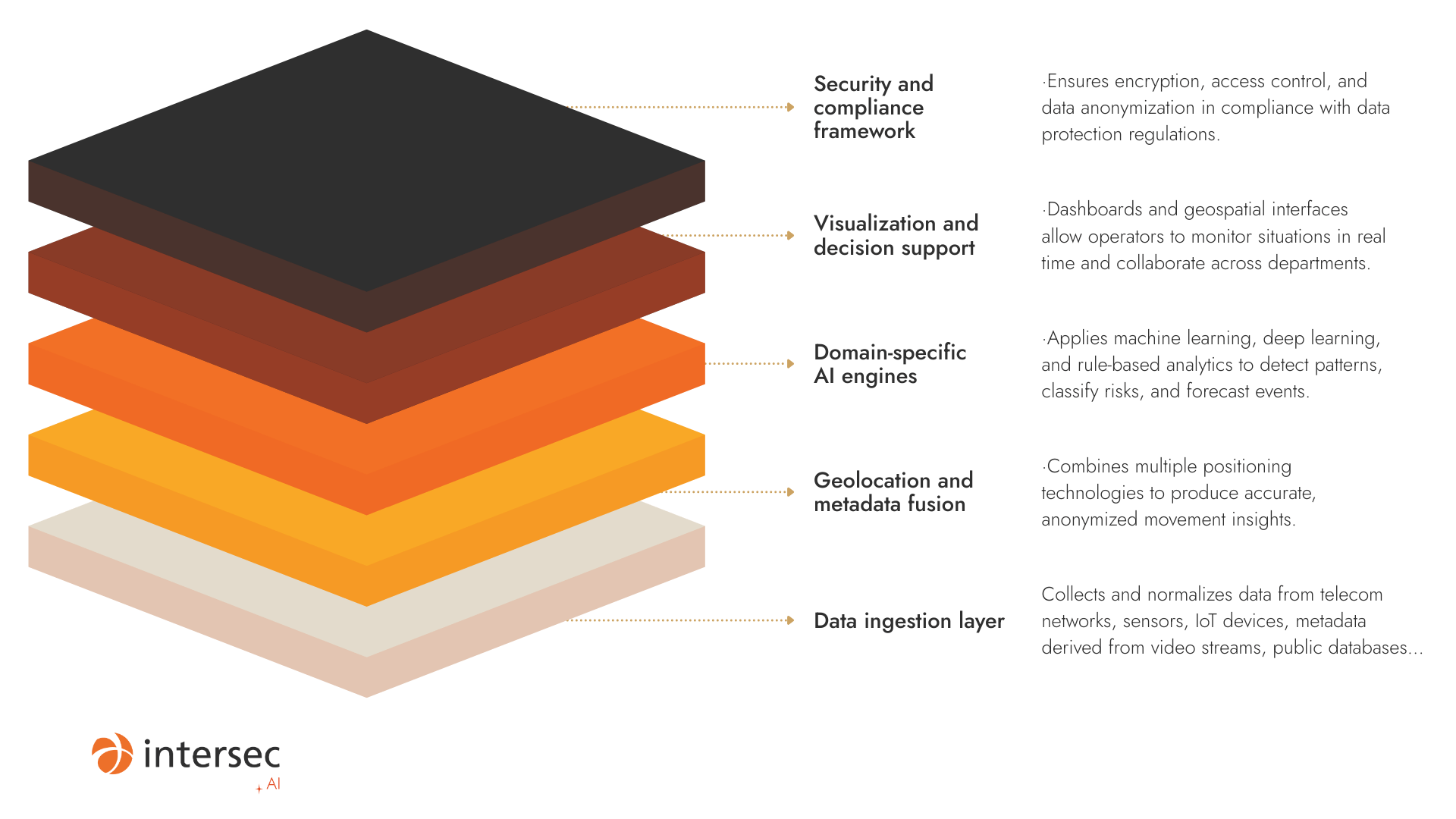
Deploying AI for public safety requires more than algorithms. It demands a secure, interoperable architecture capable of integrating heterogeneous data sources, maintaining privacy, and scaling across multiple agencies.
CORE COMPONENTS
- Data ingestion layer: Collects and normalizes data from telecom networks, sensors, IoT devices, metadata derived from video streams, public databases...
- Geolocation and metadata fusion: Combines multiple positioning technologies to produce accurate, anonymized movement insights.
- Domain-specific AI engines: Applies machine learning, deep learning, and rule-based analytics to detect patterns, classify risks, and forecast events.
- Visualization and decision support: Dashboards and geospatial interfaces allow operators to monitor situations in real time and collaborate across departments.
- Security and compliance framework: Ensures encryption, access control, and data anonymization in compliance with data protection regulations.
.jpg)
Editorial team
LinkedinThe Intersec editorial team is made up of professionals who share expert insights on AI-powered innovations, mission-critical communication solutions, and 5G location intelligence across civil protection, homeland security, and telecommunications.

Cell Broadcast Emergency Alerting live in 10 days
47 deployments. Four continents. Active conflict zones. We're not generalists who added public warning to a product catalog. This is all we do — and we're faster, deeper, and more adaptable than anyone.








.webp)


.webp)