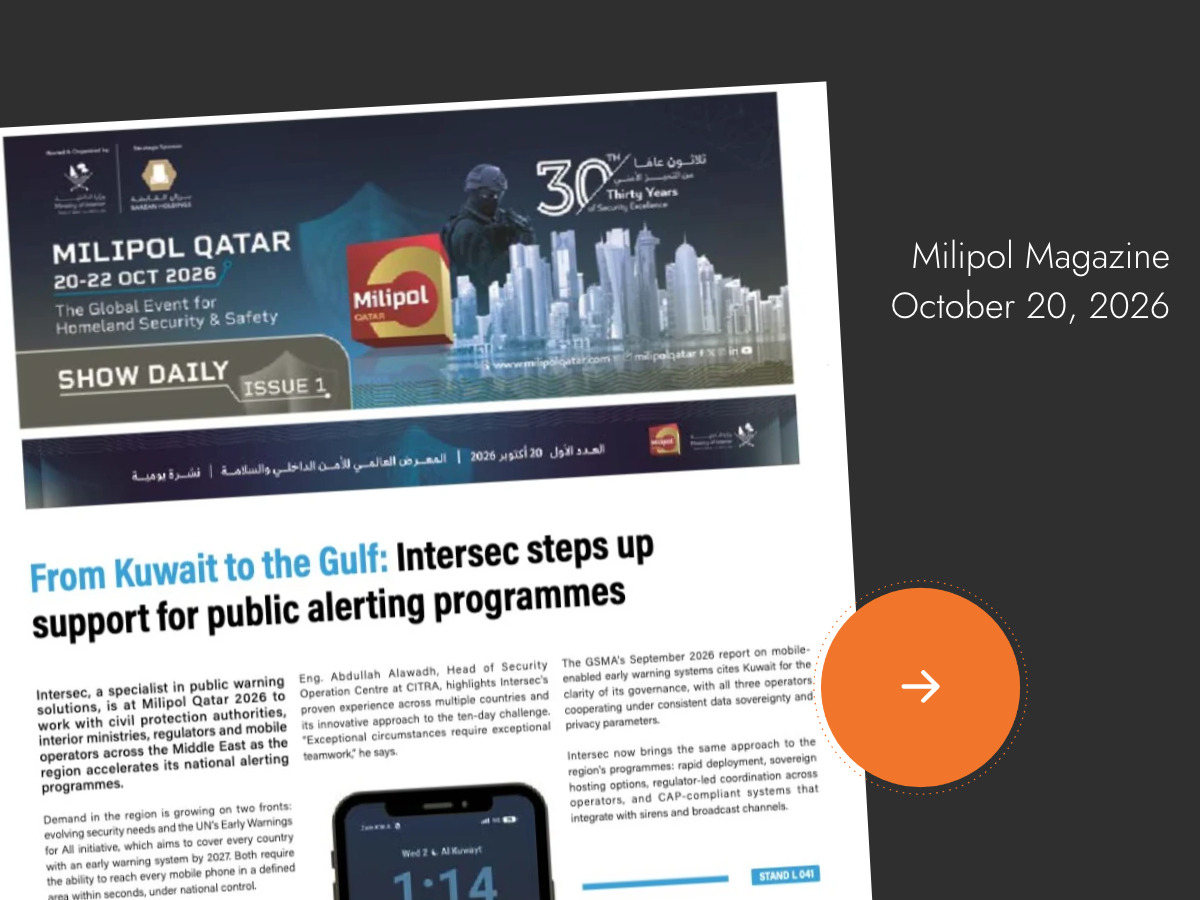
 Feature in Milipol Qatar magazine" />
At Milipol Qatar 2026, the event’s daily magazine ran a featured article on our public warning work across the Middle East. Under the title “From Kuwait to the Gulf,” it looks at how we are supporting civil protection authorities, interior ministries, regulators and mobile operators as the region accelerates its national alerting programmes.
From Kuwait to the Gulf: Intersec Steps Up Support for Middle East Public Alerting Programmes
Doha, Qatar – 20 October 2026 – Milipol Qatar 2026, Doha Exhibition and Convention Center, Pavillon France
Intersec, a global leader in public warning and location intelligence, is at Milipol Qatar this week to work with civil protection authorities, interior ministries, regulators and mobile operators across the Middle East as the region accelerates its national alerting programmes.
Demand in the Gulf and the wider region is rising on two fronts: heightened security pressures, and the UN’s Early Warnings for All commitment to have every country covered by an early warning system by 2027. Both point to the same requirement, which is the ability to reach every mobile phone in a defined area within seconds, under national control.
Intersec's work with Kuwait shows what that can look like in practice. Selected by CITRA and the country's three mobile operators, Zain, Ooredoo and STC, the company delivered a fully operational nationwide cell broadcast system in under ten days, against an industry norm measured in months. Authorities can issue geo-targeted alerts directly to handsets across four levels, from national warnings with a high-emergency tone to silent informational messages. To meet the deadline, Intersec ran the system from its secure cloud environment in France while local infrastructure was established in Kuwait in parallel.
"Exceptional circumstances require exceptional teamwork," said Eng. Abdullah Alawadh, Head of Security Operation Centre at CITRA, who credited round-the-clock work by all parties and said Intersec was chosen for its track record across multiple countries and for the approach it proposed to meet the ten-day challenge.
The model has since been picked up internationally. The GSMA's September 2026 report on designing mobile-enabled early warning systems cites Kuwait for the clarity of its governance arrangements, noting that CITRA secured simultaneous cooperation from all three operators under consistent data sovereignty and privacy parameters.
Intersec brings the same approach to the region's live programmes: rapid deployment, sovereign hosting options, regulator-led coordination across competing operators, and CAP-compliant systems that integrate with sirens and broadcast channels.
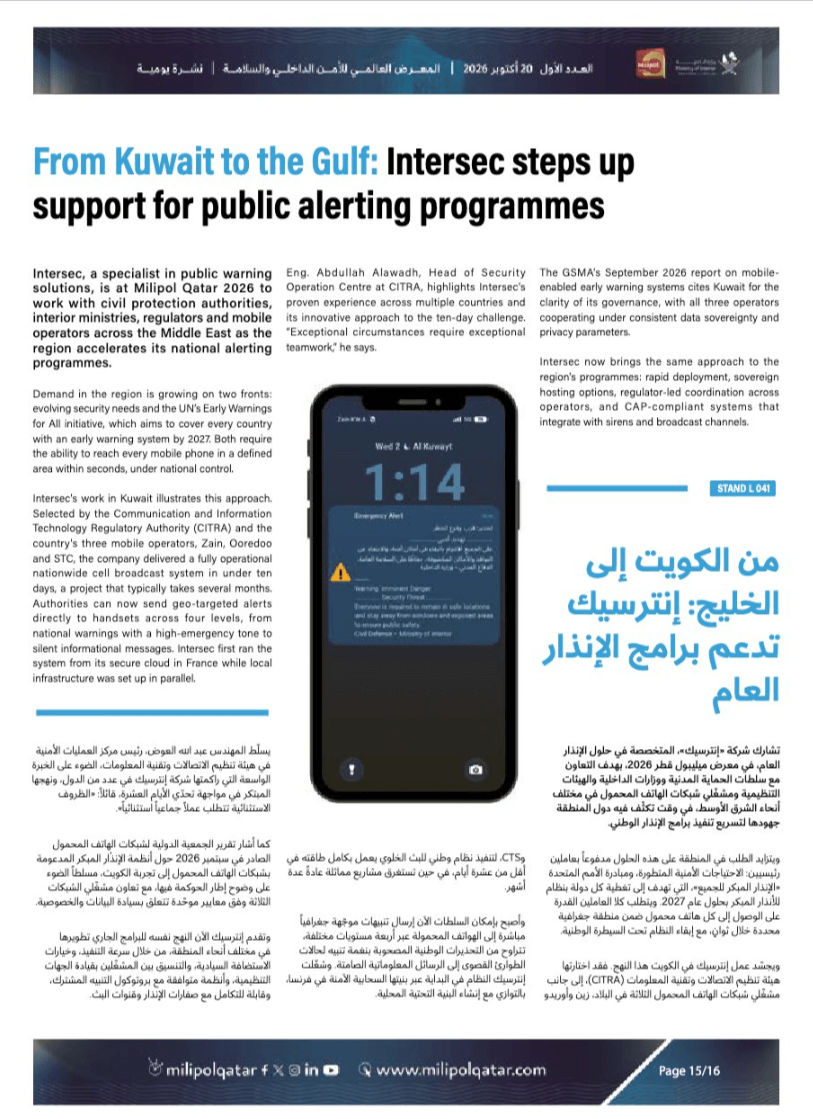
To access the digital version of the magazine, click here.
Read more
- Success story: Cell Broadcast System in Kuwait
- Press release: deploying Kuwait’s public warning system in 10 days
- Book a meeting: Cell Broadcast emergency alerting, live in 10 days

Editorial team
LinkedinThe Intersec editorial team is made up of professionals who share expert insights on AI-powered innovations, mission-critical communication solutions, and 5G location intelligence across civil protection, homeland security, and telecommunications.

Cell Broadcast Emergency Alerting live in 10 days
47 deployments. Four continents. Active conflict zones. We're not generalists who added public warning to a product catalog. This is all we do — and we're faster, deeper, and more adaptable than anyone.