.svg)
 Why combine Cell Broadcast and Location-Based SMS?" />
You think Cell Broadcast is best for severe emergencies?
No, not always.
Cell Broadcast (CB) is a technology used to send messages to all mobile phone users within a defined geographical area. It works much like radio broadcasting: messages are received by any user whose phone is switched on, even if mobile data is disabled. The system works on all types of mobile phones (not only smartphones, but also older devices) regardless of subscription type or prepaid status.
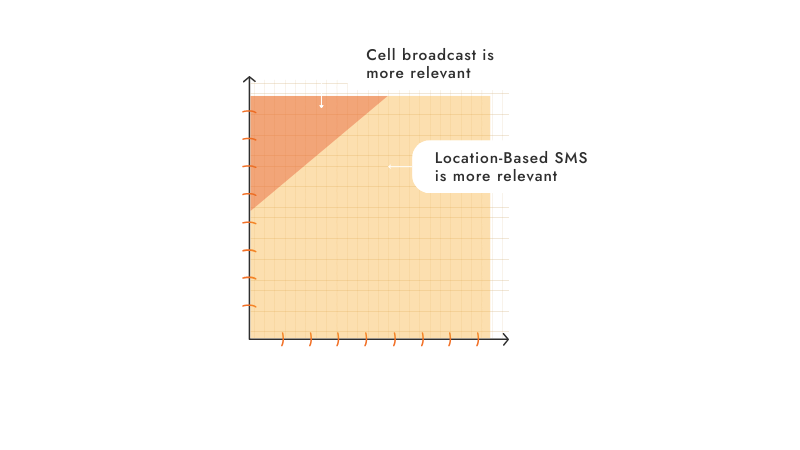
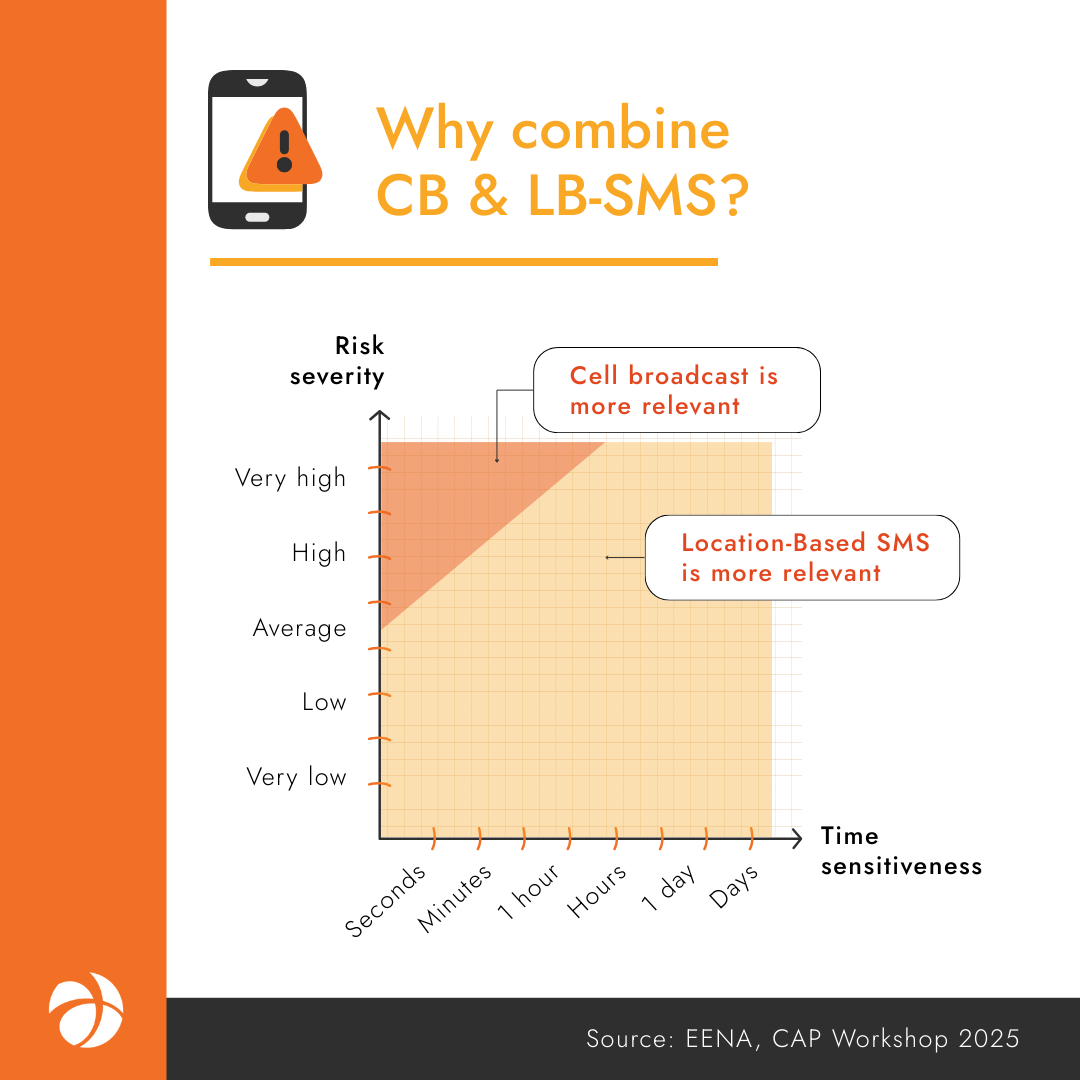
However, the severity of an incident is only one factor among many. Other key considerations include time sensitivity (whether the alert must be sent within seconds - for example, for tsunamis or earthquakes - or within minutes, as in fast-moving floods or industrial accidents) and the number of people who need to be alerted. Only a few incident types require reaching millions of people within seconds. In most cases, it is preferable to notify only the population actually at risk within a targeted area, even a large one. And no, location-based SMS does not necessarily overload the network.
Main limitations of Cell Broadcast:
- It is not ideal for the population, because the message disappears as soon as the user interacts with it, and most people do not know how to retrieve it later through their phone settings.
- It is not ideal for emergency authorities either, as they cannot know who received the alert (no delivery statistics) and cannot send follow-up communications. With location-based SMS, retargeted or follow-up messages are possible.
You think location-based SMS means network congestion?
No, not always.
The Location-Based SMS (LB-SMS) dissemination requires the use of the SMS-C platform within the mobile operator core network components. All mobile operators have this platform to handle the SMS traffic between different subscribers (Person to Person – P2P) or for different applications (Application to Person – A2P) like their own marketing teams or banking applications.
The challenge here is that the SMSC has a limited throughput (the supported number of SMS per second), and this global limit that handles the previously stated SMS types applies also to the Public Warning SMSs. Increasing this limit may become costly for the mobile operator.
To address this, Intersec provides a specific SMSC module for its warning systems (FDA or First Delivery Attempt), this module allows only the A2P SMSs and can serve thousands of SMSs per second with a very low hardware footprint. With this solution, sending LB-SMS alerts has no impact on the existing SMS traffic (no congestion on the existing SMSC platform) and can give an exact estimation of the needed time to reach the whole population.
You don't have to choose between Cell Broadcast and Location-Based SMS!
GSMA and major Mobile Network Operators - including VEON, KDDI, Globe, Safaricom, Telefónica, MTN, and Axiata Group - have issued a call to action to deploy both Cell Broadcast (CB) and Location-Based SMS (LB-SMS), leveraging digital connectivity to ensure everyone is protected. At the 2025 CAP Workshop, Benoît Vivier from the European Emergency Number Association (EENA) listed this recommendation as the top best practice for EWS implementation in the EU.
Why? In short: Cell Broadcast delivers instant, loud, distinctive alerts (audible even when a phone is on silent) to a very large population. Location-Based SMS enables sending text messages to all users within a more precisely defined area and provides more advanced crisis-management capabilities.
By combining both technologies, public authorities can adapt their communication strategy to:
- The nature of the emergency:
- Use Cell Broadcast for urgent events requiring rapid, wide-area notification (e.g., earthquakes, tsunami alerts, avalanches).
- Use Location-Based SMS for longer-lasting emergencies that require regular updates (e.g., heat waves, pandemics).
- The evolution of the situation, based on location and recipient numbers:
- Send an initial message to people directly affected,
- Send a different message to those who may be affected, and
- Issue contextualized follow-up communications as the situation evolves, using retargeting features.
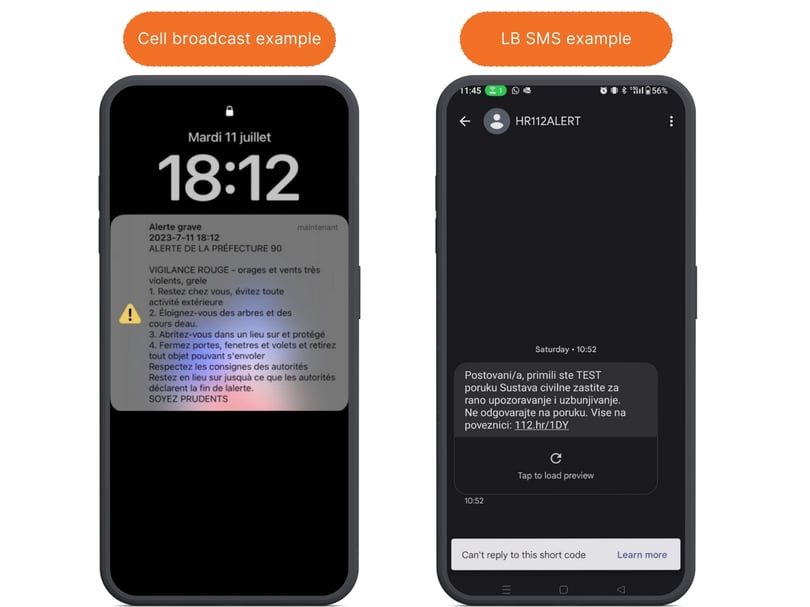
Nationwide examples of Cell broadcast and Location-Based SMS
.jpg)
Editorial team
LinkedinThe Intersec editorial team is made up of professionals who share expert insights on AI-powered innovations, mission-critical communication solutions, and 5G location intelligence across civil protection, homeland security, and telecommunications.
Cell Broadcast Emergency Alerting live in 10 days
47 deployments. Four continents. Active conflict zones. We're not generalists who added public warning to a product catalog. This is all we do — and we're faster, deeper, and more adaptable than anyone.





.webp)


.webp)