.svg)
 Why AML will not reliably locate most emergency callers anytime soon" />
Advanced Mobile Location (AML) is often presented as a major step forward for emergency response. Yet in practice, its effectiveness varies widely by geography. Depending on the country and the maturity of both handset ecosystems and emergency services, AML success rates today range anywhere between roughly 10% and 95%:
-
In highly developed markets, particularly Western Europe, AML typically delivers a usable handset-based location in around 60–70% of emergency calls.
-
In North America, where the FCC has imposed stringent handset location requirements on device manufacturers for many years, success rates can reach up to 95%.
-
By contrast, in many emerging and developing countries, AML success rates remain well below 50%, and often closer to 10–15%.
As a result, for a large share of the global population, emergency callers still cannot be reliably located using AML alone.
The myth of ubiquitous AML: why most emergency callers remain unlocated
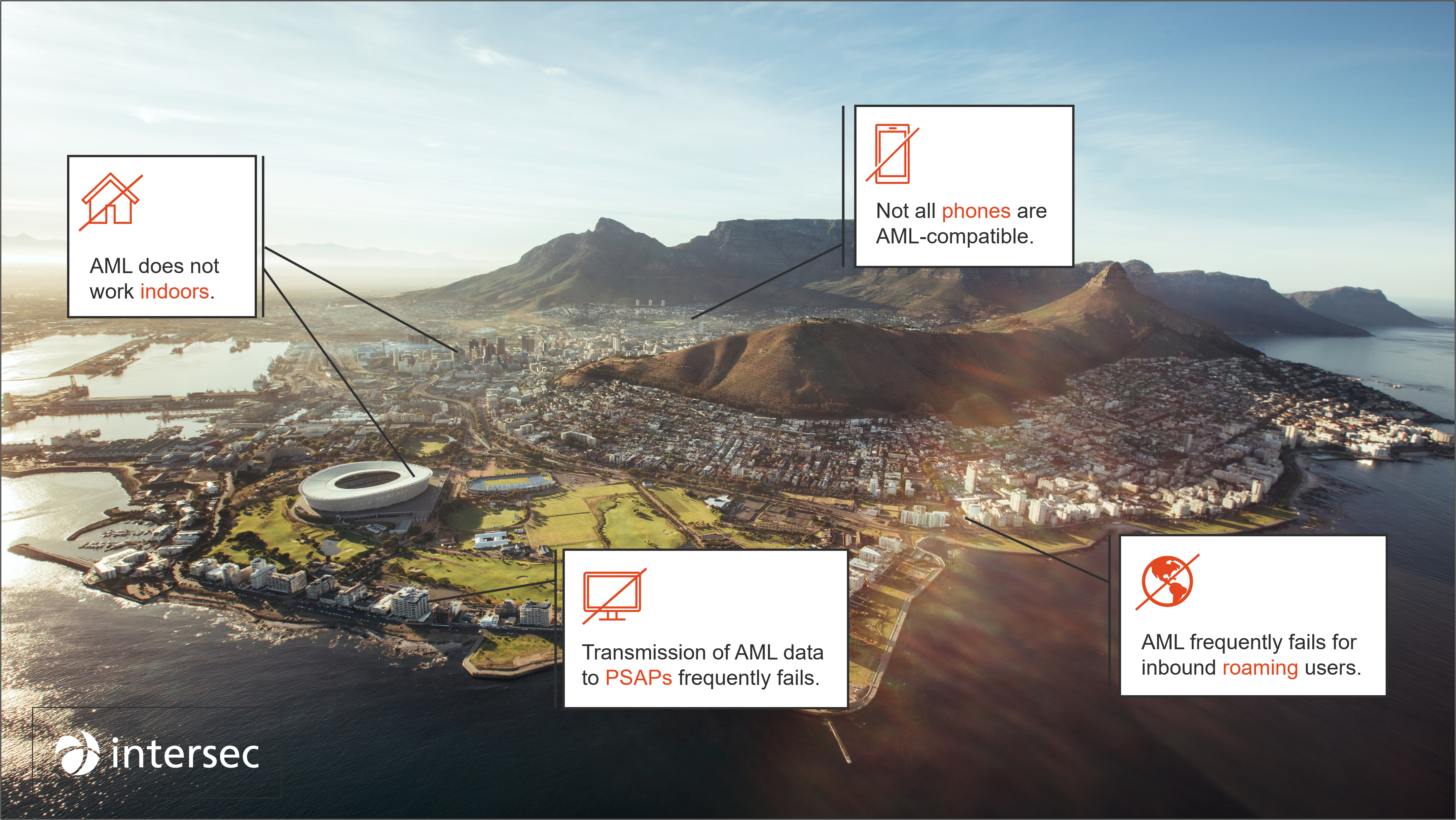
- AML depends on smartphone operating systems and device capabilities (primarily Android and iOS) and on correct configuration across the handset, mobile network, and emergency services. Smartphone penetration itself remains uneven across regions. In Sub-Saharan Africa, for example, only around 54% of mobile connections were smartphones in 2024, meaning a large share of emergency calls still originate from feature phones that cannot support AML. Even among smartphones, OS versions, vendor implementations, and emergency number configurations limit consistent AML triggering and delivery.
- In addition, AML frequently fails for inbound roaming users. Tourists and other visitors are often unable to benefit from AML due to roaming constraints, incomplete cross-border configuration, or lack of PSAP support for roaming AML messages. This is a critical limitation, as roaming callers are typically the least able to describe their location verbally and therefore stand to benefit the most from automated location technologies. For countries where tourism represents a significant share of economic activity, this remains a major unresolved challenge.
- AML has well-known technical limitations, particularly indoors. While AML can combine GNSS, Wi-Fi positioning, and cell-based signals, its accuracy and availability still degrade in buildings, dense urban environments, or underground locations, precisely where many emergency incidents occur.
- Transmission of AML data to PSAPs frequently fails. Common causes include device-side limitations (e.g. roaming mode, missing or masked MSISDNs), networks or SMS gateways not configured for AML, PSAP systems that are not AML-ready, and integration or configuration errors across the emergency response chain.
High smartphone penetration does not guarantee AML success
Even in regions with growing smartphone adoption, AML effectiveness is constrained by the readiness of emergency services infrastructure. In many African countries, for example, PSAP modernization is the primary bottleneck: most call centres rely on legacy systems that cannot ingest AML messages, and in some cases, emergency numbers are not standardized nationally. Similarly, in Latin America, AML is not mandated, emergency numbers vary by country, and emergency systems are often fragmented across police, municipal, or state agencies. Some pilot projects have introduced smartphone apps to improve caller location, but these remain limited in scope and will take years to scale.
Even in Europe, where smartphone penetration is high and AML is widely mandated, AML success is not universal. According to recent data,
“some Member States received AML location in just 40% of calls (…) while network-based location was typically provided to PSAPs in more than 97% of emergency calls in 2023. Considerable improvements are also needed to ensure that roaming users, such as tourists, can benefit from AML: as of 2023, despite 24 Member States having AML, only 8 confirmed that location information was available for roaming end users”.
These figures demonstrate that device availability alone does not translate into reliable emergency caller location. Back-end integration, PSAP readiness, and standardized deployment are equally critical.
The case for combining AML and network-derived call location
As a result, AML alone cannot guarantee reliable emergency caller location in the foreseeable future. When AML works, it often provides very high accuracy and valuable context for emergency responders. However, it is strongly suggested to complement AML with network-derived location provided by mobile operators. As a matter of fact, network-based location achieves reliability rates between 82% and 100%, works on all phones (smartphones and feature phones alike) and functions both indoors and outdoors. Even when less precise than handset-based location, network-based positioning consistently delivers an acceptable and operationally useful location.
At Intersec, our advanced location intelligence enables very high levels of accuracy and reliability by combining a broad range of active and passive network-based positioning techniques. For these reasons, and in line with the European Commission and EENA, we explicitly recommend a hybrid approach combining handset-based and network-based location as the most effective way to maximize emergency caller location coverage.
.jpg)
Editorial team
LinkedinThe Intersec editorial team is made up of professionals who share expert insights on AI-powered innovations, mission-critical communication solutions, and 5G location intelligence across civil protection, homeland security, and telecommunications.

EWS Accessibility Frameworks
Inclusive public warning without barriers
Designed to remove financial and technical barriers for eligible governments, they aim to support inclusive public warning strategies and ensure that accessibility constraints never compromise the protection of lives.
Check your eligibility to see whether your government can benefit from these frameworks and strengthen the reach and effectiveness of public warnings.
.jpg)







.webp)


.webp)